
Toward an Unoffensive Evaluation of Offensive Linemen: A Note
An attempt at a grades-free framework to evaluate offensive lineman.

I won’t mince words: Evaluating offensive line play with analytics is hard. Even harder, evaluating individual offensive linemen. Unlike “skill” positions - I do hate that distinction, as pervasive as it is - offensive line play does not show up directly in the box score, and it certainly doesn’t show up in public data analysis. There are some ways to try and get at offensive line efficiency - for example, yards before contact in the run game.
The current “least bad option” for somewhat accessible offensive line evaluation comes from PFF and their consumer-facing grades. Players are rated every play on half point increments, and then PFF does some magic post-processing to standardize those grades. Generally, they give a good overview of what an offensive line or an offensive lineman did with what they were asked to do.
In this note, I’ll seek out an alternative approach to valuing offensive line grades, using play by play data sourced from Sports Info Solutions and an approach mimicking Pro Football Reference’s Approximate Value. This post will answer the following question:
What can we deduce about offensive line play using team-level statistics and participation metrics?
Let’s dive in.
Gory Details
Here’s a general algorithm for using participation and team efficiency to evaluate offensive line play.
First, you need a metric for offensive success. I’ll use an opponent-adjusted expected points per drive metric, that I more or less made just for this purpose. I have a model that I use for my stat previews, but I won’t pretend that is the end all be all. An expected points per drive metric helps us gauge how explosive and efficient an offense is, and the opponent adjustments should help us calibrate the differences in leagues and the kinds of linemen our linemen are blocking against. I’ll standardize that so that 100 is average, and then we come to the problem of dividing credit to the offensive line.
Approximate value gives the linemen 5/11ths of the credit for offensive scoring. It’s hard to argue, given that there are generally five offensive linemen on every play. I think we can do better, tapping in again to the power rating and franchise tag weights I used in my last post about understanding team talent.
In the “Power Ratings” weight, offensive linemen are credited with 17.6% of total team rating, but 37.3% of the offensive rating. In the franchise tag weights, derived from NFL franchise tags, offensive linemen are 10% of the team total, 19.8% of the offensive total. We’ll use those as our weights, and assign 37.3% (high end) and 19.8% (more reasonable, off the top of my head) of the standardized team expected points per drive metric to the offensive line.
Then, eschewing the distinction between run and pass - a poor assumption for reality but a convenient one for this quick applied exercise - we’ll distribute those points to offensive linemen based on snaps, with tackles getting a slight premium position bump (say 1.2 to 0.8 for interior offensive line). The result will be a player-level opponent-adjusted points contribution to a team. Note that we restrict our analysis to FBS vs FBS situations only.
Results
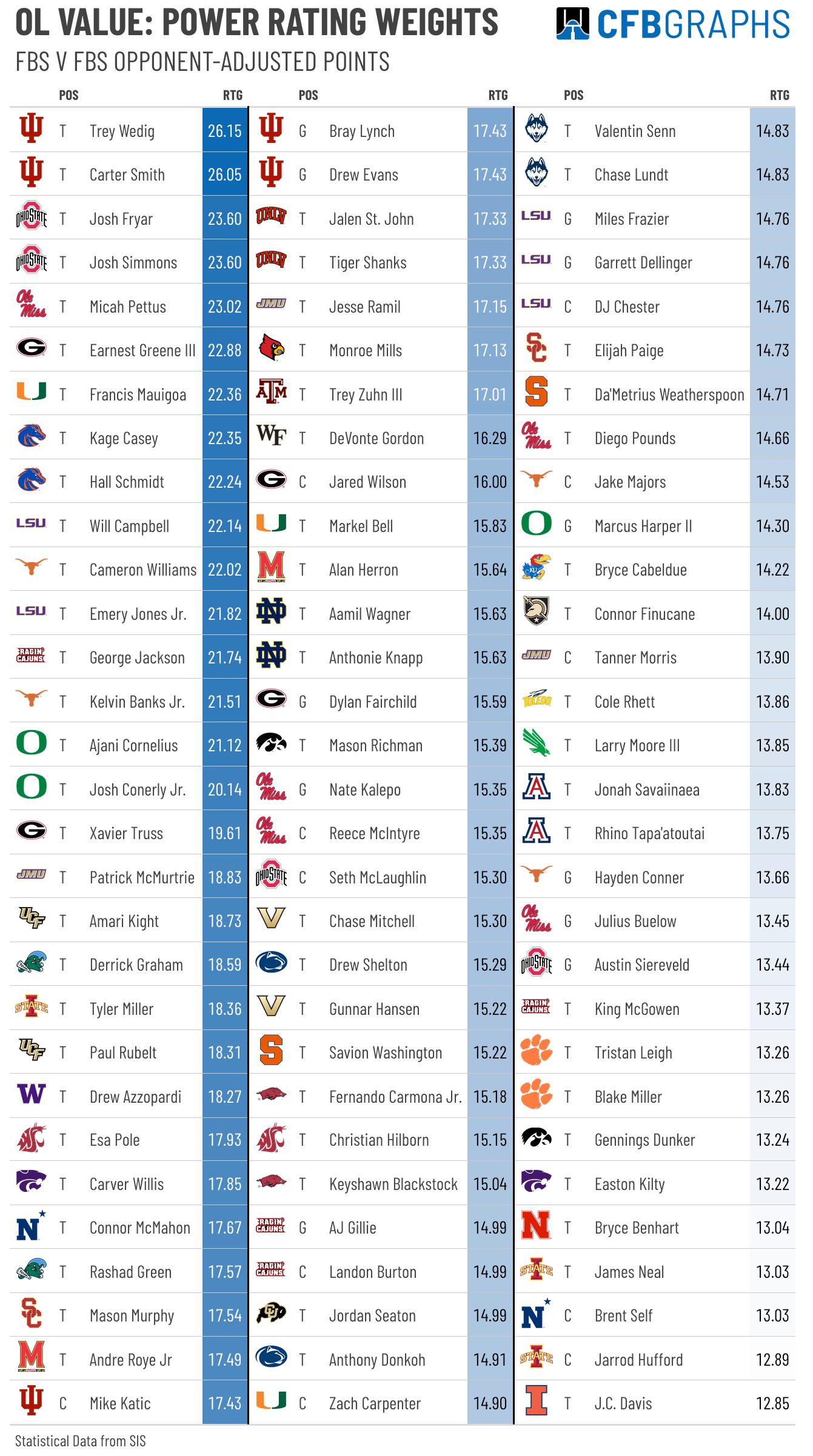
Here’s the chart with the Power Ratings Weights
And with the Franchise Tag weights, which I believe are more appropriate upon inspection - I don’t know much about offensive line play, but I do not an offensive lineman is not worth 26 points through 5 games. Or at least I think I know that. Who knows.
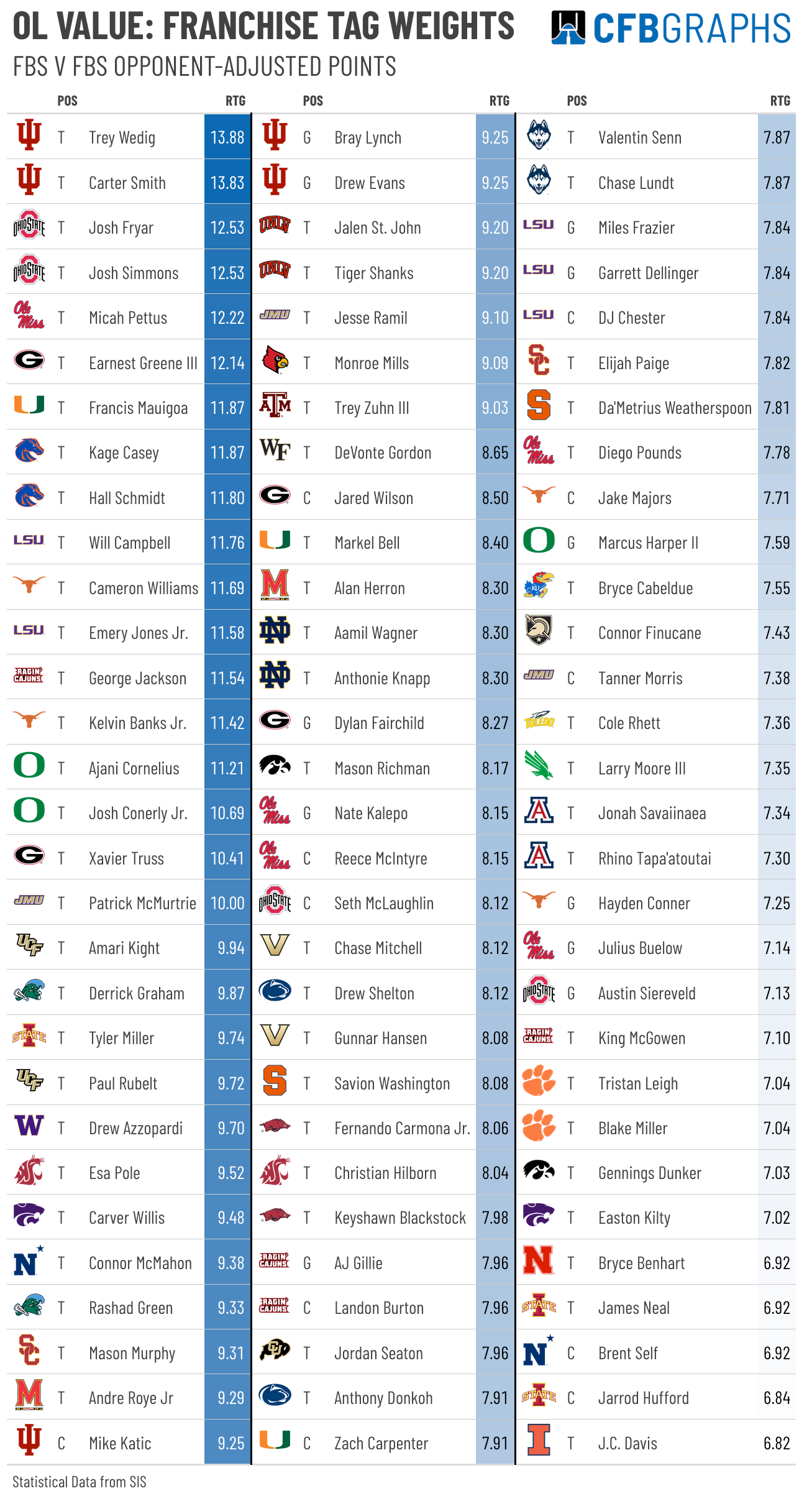
Ordering is of course, the same. Scale is much more reasonable! We see a bunch of linemen from Indiana towards the top, shout out to the Hoosiers and Coach Cig for their hot start. We also see some blue blood tackles from Ohio State, Texas, and some excellent rushing attacks - Boise, UNLV, Iowa State, UCF, Tulane all represented at the top. I’ll leave inspection of the individuals up to the reader, and talk more about what an approach like this means.
Conclusion
So, what have we done today? Well, in addition to killing the time until Texas State and Troy kick off, we’ve used team level efficiency and offensive line participation to start to cobble together a list of the most “valuable” linemen in CFB. Now, some caveats and future research. First, it should be said that this is nowhere near a list of the most talented or best offensive linemen in college football. Instead, I think this foundation is an interesting approach at identifying the offensive linemen who are most involved on good teams - particularly useful, in conjunction with opponent-adjusted metrics, to identify key offensive linemen on lower level teams that might be useful to some P4 teams in the future. Nothing beats experience for offensve linemen, and being able to sift through the experienced players with a measure of quality becomes particularly useful.
Caveats: This is a pretty bad metric. It allows for no good linemen on bad teams. It allows for no asymmetry in offensive line performance. It knowns nothing about the physical traits of the linemen, nor about what decisions an offense has to make because of the quality of the offensive line - are we throwing more screens? Do we have to keep extra protection in obvious passing situations? Are we having to run zone schemes instead of gap? and on and on.
Consider this nothing more than a quick exercise to kill some time and get my hands dirty in R. I’ve effectively replicated Approximate Value with a better weighting of OL importance and with a more calibrated metric of offensive success.
Future research would have to dive into calibrating the weight for OL, trying to ingest some information about OL physical traits, and into refining the measures of offensive efficiency. Of course, we haven’t even opened the can of worms that is accounting for rushing and passing splits, which is a huge component as well.
Nothing in this note is necessarily groundbreaking, but as I alluded to in my “dusting off the substack” post a couple weeks back, it’s a net positive for my brain to think of something silly like this and put it on paper.
Enjoy the weekend of football.